
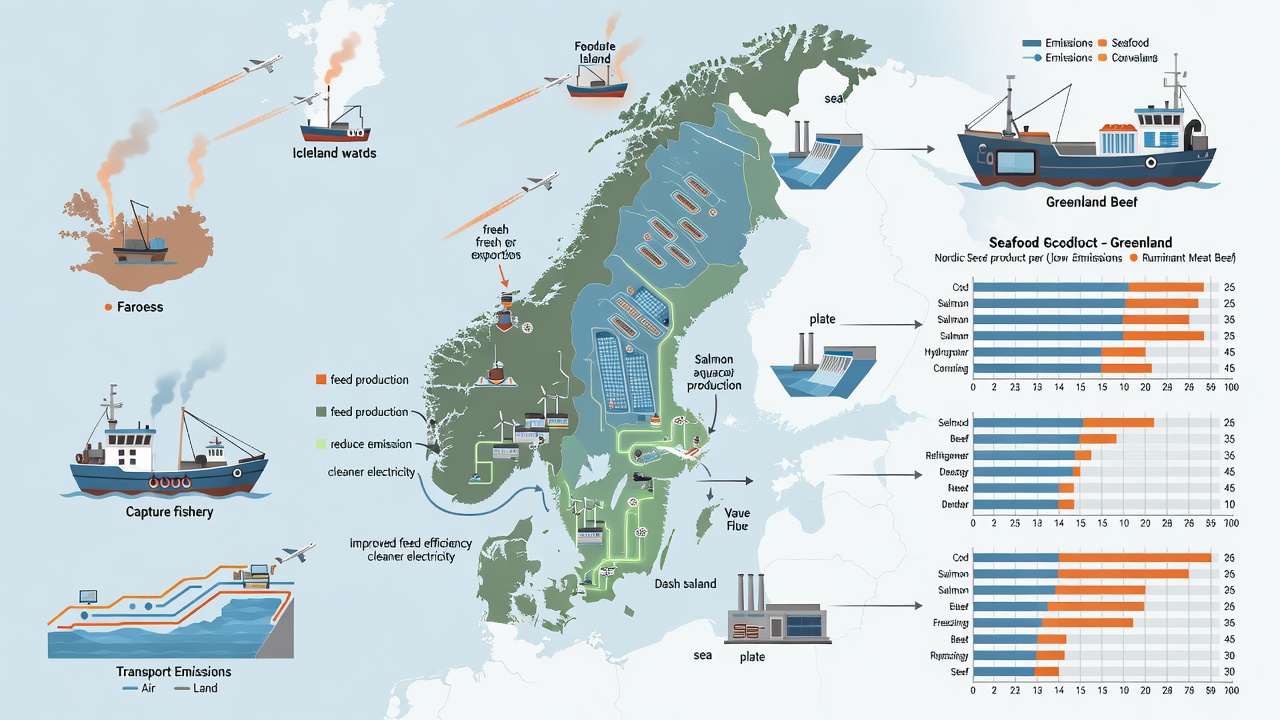
A new regional assessment shows that the climate footprint of aquatic food varies widely by species, production method and country. The report, covering five Nordic nations plus the Faroe Islands and Greenland, argues that climate measures should focus on the specific stages of the value chain where emissions are highest.
Where the emissions come from
The report identifies a few recurring sources. In fisheries, fuel consumption is the dominant contributor. In aquaculture, feed production and feed composition account for the largest share. In processing, energy use, refrigeration and freezing play a major role. Transport matters too: air freight of fresh fish can substantially raise its climate footprint, although the effect depends on the route and the product.
How seafood compares with other protein
Despite these differences, the researchers found that many Nordic aquatic food products have a lower climate footprint per kilogram than several animal-based agricultural products, particularly meat from ruminants. That comparison helps explain why the report resists treating seafood as one uniform category. Its climate profile depends on how each product is caught or farmed, processed and shipped.
Country-level differences
The main sources vary from one country to another. Denmark has cut aquaculture emissions through better feed efficiency and a cleaner electricity mix. In the Faroe Islands, fisheries are among the largest individual sources, and air freight adds to the footprint of some exports. In Norway, feed is the largest source of emissions in salmon farming, while Iceland's emissions are dominated by its fishing fleet. In Greenland, the report notes that fossil fuel use in processing could be reduced substantially through access to hydropower.
What the findings are based on
The report was produced by researchers from leading Nordic research institutions and universities. It draws on 2023 emissions and production data, along with life cycle assessments and industry data from across the region. Its stated goal is to give policymakers, researchers and industry a shared evidence base for the green transition in the Nordic aquatic food sector.