
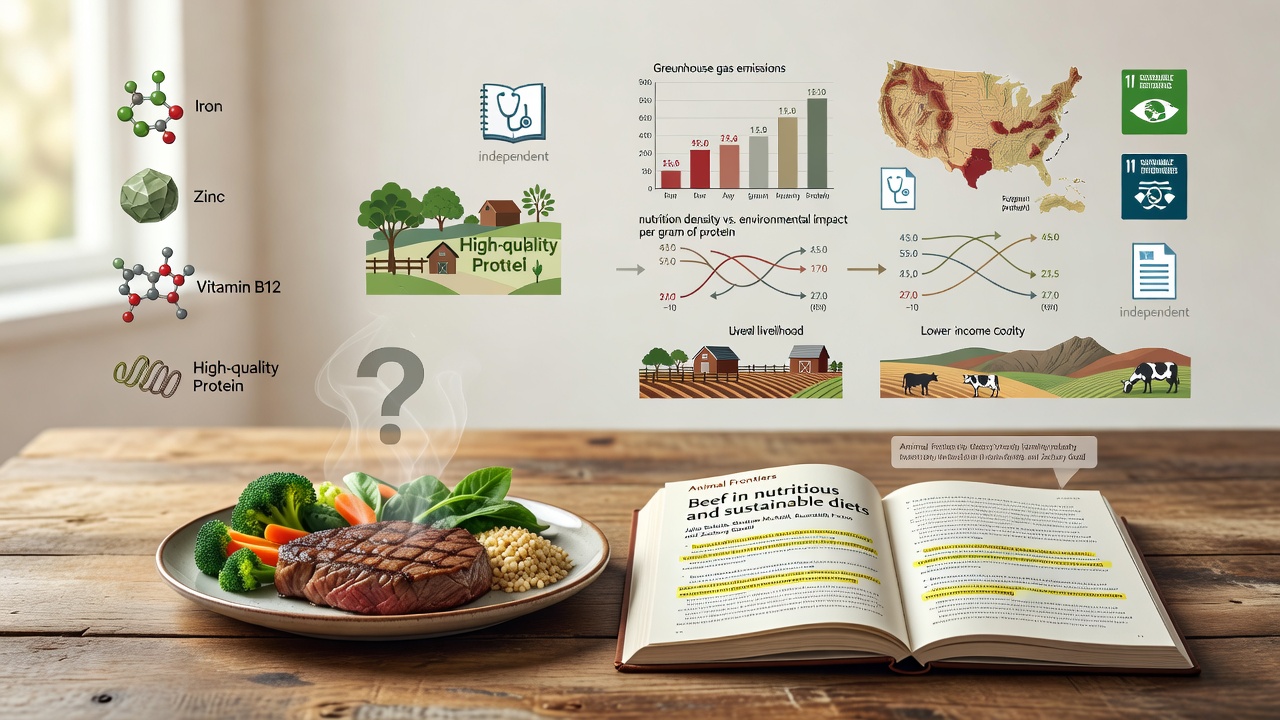
A recent review in the journal Animal Frontiers argues that moderate beef consumption can fit within healthy, sustainable eating patterns. The paper, Beef in nutritious and sustainable diets, was written by Julia Sekula, Shalene McNeill, Ruaraidh Petre and Zachary Gould, three of whom work for beef-sector organizations. For American readers weighing whether to keep beef on the dinner table, the paper offers a useful summary of the case for beef, along with reasons to read its conclusions carefully.
What the authors argue
The review makes three main claims. First, beef is a concentrated source of high-quality protein and micronutrients the body absorbs well, including iron, zinc, vitamin B12 and other nutrients that many diets fall short on. Second, the authors say that across the available evidence, moderate beef intake within a balanced diet has not consistently worsened measured cardiometabolic risk markers in controlled trials. Third, they argue that food policy should weigh nutrient density, land use and rural livelihoods alongside environmental impact, rather than relying mainly on comparisons by weight or calories.
That third point matters. Beef has a large greenhouse-gas footprint per gram of protein, and simple per-kilogram comparisons tend to make it look worse than foods that deliver less nutrition per unit. The authors also tie beef production to Sustainable Development Goals on poverty, nutrition and economic resilience, particularly in lower- and middle-income countries, where cattle can be a source of income, savings and food security.
Who wrote it, and why that matters
The paper is a review and opinion piece, not a new trial. It was invited by the US Roundtable for Sustainable Beef, and the authors disclose employment with Beef + Lamb New Zealand, the National Cattlemen's Beef Association and the Global Roundtable for Sustainable Beef. Those affiliations do not make the arguments false, but they mean the piece was written to make a favorable case for beef. The authors themselves describe its purpose as showing that beef intake is consistent with sustainable food systems.
Readers should also notice what the review does not do. It does not define "moderate." A serving of beef a few times a week and a daily steak can both be called moderate by different people, and the health and environmental answers differ a great deal between them. The review's conclusions depend on that undefined term.
Practical implications for a household
- Beef's nutrients are real. Lean cuts can help people who struggle to get enough iron or B12, though plenty of other foods supply both.
- The environmental picture depends on how much beef a household eats, how the animals are raised and which cuts are chosen. A review written by the industry does not settle those questions.
- If you are managing a specific health condition, such as heart disease or diabetes, the appropriate amount of red meat is a question for your own clinician, not a general review.
The paper's strongest contribution is a reminder that food choices involve trade-offs among nutrition, cost, farm livelihoods and emissions. Its weakest point is that the people making the case for beef are the same people who would benefit from a favorable conclusion. Read it as one perspective in a larger body of evidence, and check independent sources, including public health guidance and peer-reviewed work outside the beef sector, before deciding how much beef belongs in your own weekly menu.